Panama · Kunaisa and the Wargandí Gaming Commission · register read 3 October 2026
Kunaisa Gaming Licence 2026: What the Wargandí Register and Panama's Law Show
Kunaisa is a licensing body created by an indigenous congress in eastern Panama in October 2025. Agents sell its gaming licence from about EUR 19,500. Its register lists no gaming licensee yet, and the Panamanian state has its own gambling regulator under a constitutional monopoly.
A Kunaisa gaming licence is an annual, internet-only authorisation issued by the Kuna de Wargandí International Services Authority, a body created by the General Congress of the Kuna de Wargandí comarca in Panama on 19 October 2025, which by its own rules is void for any use inside Panama and is not issued by the Panamanian state regulator, the Junta de Control de Juegos.
Quick facts
| Parameter | Value |
|---|---|
| Issuer | Kuna de Wargandí International Services Authority (Kunaisa), created by Resolution 001 of the comarca's General Congress, 19 October 2025; the Wargandí Gaming Commission (WGC) is its gaming division |
| Gaming rules | Annex III to Resolution 002 of 18 January 2026, the "Wargandí Law on iGaming" V1.0.0: seven clauses, six licence types (A to F) |
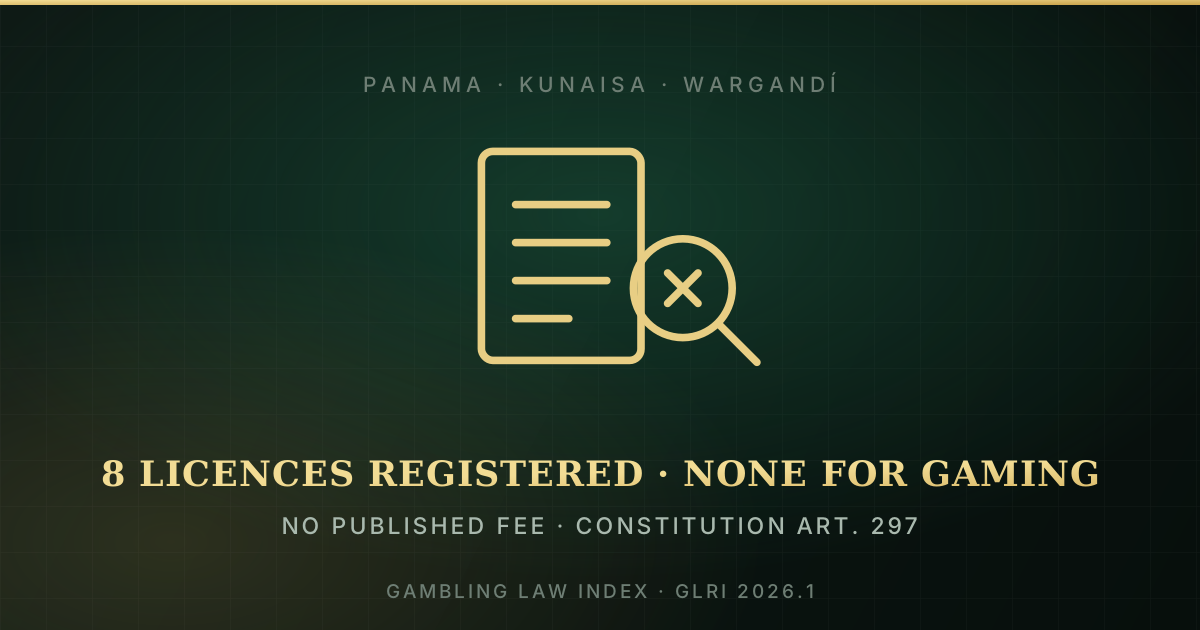
| Register on 3 October 2026 | Eight licences: four forex, four VASP, no iGaming. Seven companies; first issue 27 January 2026, latest 31 August 2026 |
| Territorial scope | Internet only; licensees must geo-block Panama, the United States and OFAC-sanctioned countries (Annex III cl. 2). Use inside Panama is "explicitly prohibited and void" (Resolution 002, Third (a)) |
| Official fees | Not published. Annex III cl. 6 leaves prices to an "official note"; the WGC says the fee structure is given at pre-application |
| Agent price and timing | An agent writing in Yogonet on 20 July 2026 quotes packages from about EUR 19,500 and about four weeks; the WGC's own FAQ says 4 to 8 months |
| State position on gambling | Constitution art. 297: gambling may be operated only by the State. Decreto Ley 2 of 1998 arts 1 to 3: through the Junta de Control de Juegos |
| Relation to the Panamanian government | Kunaisa's press release of 20 April 2026 says it is not, and does not present itself as, an official authority of the Government of Panama |
What Kunaisa is
Kunaisa stands for Kuna de Wargandí International Services Authority. The General Congress of the Comarca Kuna de Wargandí, an indigenous territory in Darién province, created it by Resolution 001 of 19 October 2025. The resolution authorises it to issue licences “in sectors such as iGaming and its derivatives; Forex and its derivatives; Crypto assets”, and gives it legal personality through a company, KUNAISA Inc., described as a “Territory–private partnership” to be registered in Panama’s Public Registry.
The gaming side has a second name. The Wargandí Gaming Commission (WGC) describes itself as “a division of KUNAISA” that evaluates and supervises gaming licensees, while Kunaisa remains the issuing entity. Its site says its board “is currently being constituted”, its technical resolutions are “pending publication”, and its catalogue of fees and requirements is “in preparation”.
Kunaisa is not the Panamanian state. Its press release of 20 April 2026 calls it “categorically false” that Kunaisa presents itself as an official authority of the Government of the Republic of Panama. The same release says Panama’s banking superintendency confirmed that Kunaisa holds no banking or fiduciary licence, which Kunaisa says it neither has nor needs.
Who runs the commercial side
Resolution 001 appointed a private company as Kunaisa’s exclusive “Commercial Committee” for 20 years. Three months later the Congress replaced that clause. Under Resolution 001 of 18 January 2026 the exclusive commercial partner is Wargandí Worldwide Corp., registered under folio 155776761 of the Public Registry of Panama, for a renewable ten years. It markets the licences, deals with agents and licensees, and collects the sale and renewal payments before passing Kunaisa its share.
The same resolution moves the risk to that company. Wargandí Worldwide Corp. assumes “all legal, financial, civil, administrative, criminal, and regulatory responsibility” arising from licensees’ activities, AML compliance and the handling of funds, and indemnifies the comarca, its Congress and Kunaisa against claims “including but not limited to fraud, money laundering, scams”. The comarca “will not be liable for any debts, obligations, or losses”. So the body whose name is on the licence has, in its founding documents, placed liability for the licensing system on the company that sells it.
Kunaisa reported its first income on 19 April 2026: USD 6,000, handed over at the General Congress in Nurra as payment for a licence.
What the gaming rules contain
The whole gaming regime is Annex III to Resolution 002 of 18 January 2026, titled “Wargandí Law on iGaming”, version 1.0.0. It has seven clauses.
| Clause | What it says |
|---|---|
| 1. Purpose | Kunaisa issues “international-use licenses” to Wargandí international business companies in the gambling industry |
| 2. Scope | Internet only; access from Panama, the United States and OFAC-sanctioned countries must be blocked by IP geolocation |
| 3. Types | A online casino, B sports betting, C prediction platforms, D virtual raffles, E online lottery, F blockchain-based gambling |
| 4. Requirements | Eleven items filed through an authorised agent: incorporation documents, IDs of owners and directors, business plan, first-year projection, player policies, AML manual, technology report, compliance officer, forms, the fee, a notarised declaration |
| 5. Renewal | Every year, applied for at least 30 days ahead, on payment of the annual fee |
| 6. Fees | ”Established through an official note” of Kunaisa |
| 7. Changes | Kunaisa may modify, amend or expand the regulation itself |
Annex I adds that the licensee must be a Wargandí IBC with a minimum declared capital of USD 50,000, at least one director and one member. Resolution 002 itself states that use of these companies and licences within the Republic of Panama is “explicitly prohibited and void”.
The annex sets no capital adequacy test for gaming, no rule on player funds, no technical standard, no sanctions scale and no appeal. The WGC site describes fund segregation, RNG certification and a sanctions regime as subjects its resolutions regulate, and says those resolutions are not yet published. Kunaisa’s own iGaming page listed, on 3 October 2026, eight entries under “Regulatory framework” that still read as template placeholder text.
What the register shows
The WGC’s FAQ says an operator that claims a licence and is not in the public register at kunaisa.com “does not have legitimate authorization”. We read the register on 3 October 2026 and counted the entries in the page markup, leaving out commented-out blocks.
| Licence type | Entries | Numbers |
|---|---|---|
| Forex | 4 | FX0012026 to FX0042026 |
| VASP | 4 | V0032026 to V0062026 |
| iGaming | 0 | none |
Eight licences, seven companies (one holds both a forex and a VASP licence). The first was issued on 27 January 2026, nine days after the Congress approved the regulatory framework; the latest on 31 August 2026. No gaming licence appears. Either none has been issued in the regime’s first eight months of licensing, or the register is incomplete, and the WGC’s own test treats an unlisted operator as unlicensed.
A casino site that shows a Kunaisa or Wargandí seal today should be checked against that register by licence number before anything else.
What it costs and how long it takes
There is no official price. The annex defers to an official note that is not on the legal-framework page, and the WGC’s FAQ says the fee structure, made up of an application fee, an annual licence fee and a supervision fee, “is provided during the pre-application phase”.
The public figures come from sellers. An analysis published by Yogonet on 20 July 2026 and signed by Vantegris, a consultancy that describes itself as an authorised intermediary for the regime, says packages currently start from about EUR 19,500 (our translation from the Spanish), including the first gaming domains, and that a typical application takes about four weeks. The WGC’s FAQ says the process “typically takes between 4 and 8 months”. On 3 October 2026 Kunaisa’s directory of exclusive authorised resellers listed three names in its live markup, and Vantegris was not one of them; the directory notes that B2B agents are handled by a master reseller.
For scale: the state route under Resolución 65 of 2002 is a USD 40,000 derecho de llave plus USD 20,000 a year, as set out on our Panama licence page. The Kunaisa route is cheaper on an agent’s quote, but the two are not the same kind of document.
What Panama’s law says
Kunaisa and the WGC name the same legal basis everywhere: articles 88, 90 and 127 of the Constitution, Law 34 of 2000, Executive Decree 414 of 2008 and the UN Declaration on the Rights of Indigenous Peoples. We read the first two.
| Provision | What the text says |
|---|---|
| Constitution art. 88 | Indigenous languages are to be studied, conserved and promoted; bilingual literacy programmes |
| Constitution art. 90 | The State recognises and respects the ethnic identity of indigenous communities and promotes their development |
| Constitution art. 127 | The State guarantees indigenous communities the reserve of necessary lands and their collective ownership |
| Constitution art. 297 | ”La explotación de juegos de suerte y azar y de actividades que originen apuestas, sólo podrán efectuarse por el Estado” |
| Decreto Ley 2/1998 arts 1-3 | The State operates gambling through the Junta de Control de Juegos; no natural or legal person may operate it; the Junta may act directly or through third parties |
| Decreto Ley 2/1998 art. 5 | Gambling carried out abroad by electronic or other remote means “must also be supervised and regulated” |
| Decreto Ley 2/1998 art. 87(1) | Operating any game of chance without the Junta’s prior authorisation is an infraction |
| Ley 34/2000 art. 4 | Resolutions of the General Congress bind within the comarca and “must not be contrary to the Political Constitution or the laws of the Republic” |
| Ley 34/2000 art. 8 | The comarca is a special political division within Darién province with the category of corregimiento, subject to the Constitution |
Three points follow from the texts alone.
First, the three constitutional articles Kunaisa cites deal with language, cultural identity and collective land. None mentions self-determination, regulatory power or licensing. Kunaisa’s resolutions describe them as recognising “general guarantees of self-determination”; that is its reading, not their wording.
Second, Kunaisa’s site says Law 34 “grants the Kuna de Wargandí Tribe economic, financial, and operational independence and autonomy”. The law has 24 articles. A search of its text finds no form of the words autonomy or independence, and nothing on licences, financial services or gambling. Its economy chapter (arts 20-21) is about state budget allocations and national development plans.
Third, article 297 is not on Kunaisa’s list. It reserves the operation of gambling to the State, and Decreto Ley 2 names the Junta de Control de Juegos as the State’s channel. Kunaisa’s design answers this by exclusion: the licence is void in Panama and Panama is geo-blocked. Whether licensing gambling offered only to foreigners, from a comarca, falls outside article 297 and Decreto Ley 2 is a legal question no Panamanian court has answered. Article 5’s second sentence, on remote gambling carried out abroad, is the provision an adviser should be asked about.
Our reading of the texts is that the comarca’s power to license gambling is asserted in its own resolutions and is not found in the national provisions those resolutions cite.
What a licence would and would not do
A Kunaisa licence would give an operator a certificate, a register entry and a Wargandí IBC. On the documents, it would not give state recognition in Panama, a regulator that hears player complaints, or any published standard a counterparty can check compliance against. The WGC’s FAQ adds that international validity “depends on the recognition criteria of each jurisdiction where the operator wishes to serve”.
That last point applies to every offshore licence, including Anjouan and Kahnawake. The difference is the evidence available. Anjouan’s regulator publishes its fee schedule and a register searchable by licence number, company or domain. Kunaisa, on 3 October 2026, publishes no fee and lists no gaming licensee.
What we could not read
Executive Decree 414 of 22 October 2008, the comarca’s Organic Charter, was not available from any source we could open, so article 12 of the Charter, which the resolutions cite as the Congress’s power to act, is unread here. We did not see KUNAISA Inc.’s articles of incorporation or the Public Registry entry for Wargandí Worldwide Corp.; the folio number is as printed in the resolution. The resolutions were read in Kunaisa’s own English translations. We found no statement about Kunaisa from the Junta de Control de Juegos and no court decision. The statement by Zitadelle AG that Kunaisa’s April press release answers was not found, so only Kunaisa’s account of it is reported. Domain records show kunaisa.com registered on 21 September 2025 and wargandigaming.com on 15 May 2026.
For the state regime, see the Panama jurisdiction profile.
Regulator, fees, tax and status in one place: Panama gambling licence.
Pitfalls and nuances
1 Reading "Panama licence" as a state licence
Kunaisa's pages are titled "iGaming License in Panama". The issuer is a comarca body, and it says itself that it is not a Government of Panama authority. A bank or payment provider that checks with the Junta de Control de Juegos will not find the licensee there.
2 Budgeting from an agent's quote
No official fee schedule is public. Annex III leaves issuance and renewal prices to an official note, and the licence renews every year, so the second-year cost is not fixed by any document an applicant can read in advance.
3 Planning on four weeks
The four-week figure is an agent's. The Wargandí Gaming Commission's FAQ says 4 to 8 months from formal submission to decision. The two cannot both describe the same process.
4 Expecting the regulator to handle player disputes or losses
The WGC states that it does not adjudicate individual player claims and does not guarantee player funds if an operator fails. Disputes go to a private ADR provider that each licensee appoints.
5 Treating the Kahnawake comparison as settled
Promoters compare Wargandí to Kahnawake and Tobique. That comparison rests on Canadian constitutional law. In Panama the text to read is article 297, which reserves gambling to the State, and nobody has tested Kunaisa against it in court.
Frequently asked questions
What is Kunaisa?
The Kuna de Wargandí International Services Authority, created on 19 October 2025 by the General Congress of an indigenous comarca in Darién, Panama, to issue forex, VASP and iGaming licences for international use.
Is a Kunaisa gaming licence issued by the government of Panama?
No. Kunaisa's own press release of 20 April 2026 says it is not an official authority of the Government of Panama. The state gambling regulator is the Junta de Control de Juegos.
How many gaming operators hold a Kunaisa licence?
None that the register shows. On 3 October 2026 it listed eight licences, four forex and four VASP, held by seven companies. The iGaming filter returned no entry.
How much does a Kunaisa gaming licence cost?
Kunaisa publishes no fee. Its rules leave prices to an official note. An agent quoted packages from about EUR 19,500 in July 2026; that is an agent's price, not an official schedule.
Can a Kunaisa licensee take players in Panama?
No. Annex III requires geo-blocking of Panama, the United States and OFAC-sanctioned countries, and Resolution 002 declares any use of the licence within Panama prohibited and void.
Does Panamanian law give a comarca power to license gambling?
Law 34 of 2000 does not mention gambling or licensing, and article 297 of the Constitution reserves gambling to the State. No court ruling or Junta de Control de Juegos statement on Kunaisa was found.
Free editorial shortlist
Choosing a firm for a Panama licence?
Tell us your market, product and stage. We reply by email with firms from our index matched to that brief.
- No fee to you
- Firms cannot pay to be on it
- Any sponsored line is labelled (disclosure)
Sources cited
- Constitución Política de la República de Panamá (Ministerio Público edition), arts 88, 90, 127 and 297 — regulation
- Decreto Ley No. 2 of 10 February 1998, Gaceta Oficial 23,484 (MEF-hosted PDF) — regulation
- Ley No. 34 of 25 July 2000, Que crea la Comarca Kuna de Wargandí, Gaceta Oficial 24,106 — regulation
- Kunaisa: Resolution No. 002 of 18 January 2026 with Annexes I to IV (Kunaisa's English translation) — official document
- Kunaisa: legal framework page (Resolutions 001 of October 2025, 001 and 002 of January 2026) — official document
- Kunaisa: public register of licensed companies — official document
- Kunaisa: press release of 20 April 2026, clarification regarding inaccurate information — official document
- Wargandí Gaming Commission: FAQs — official document
- Yogonet, 20 July 2026: analysis of Kunaisa signed by Vantegris, a licensing consultancy — industry publication