Portugal · SRIJ (Turismo de Portugal) · register counted 19 November 2026
Portugal Online Gambling Licence: SRIJ Fees From March 2026 and What the 8% Betting Tax Costs
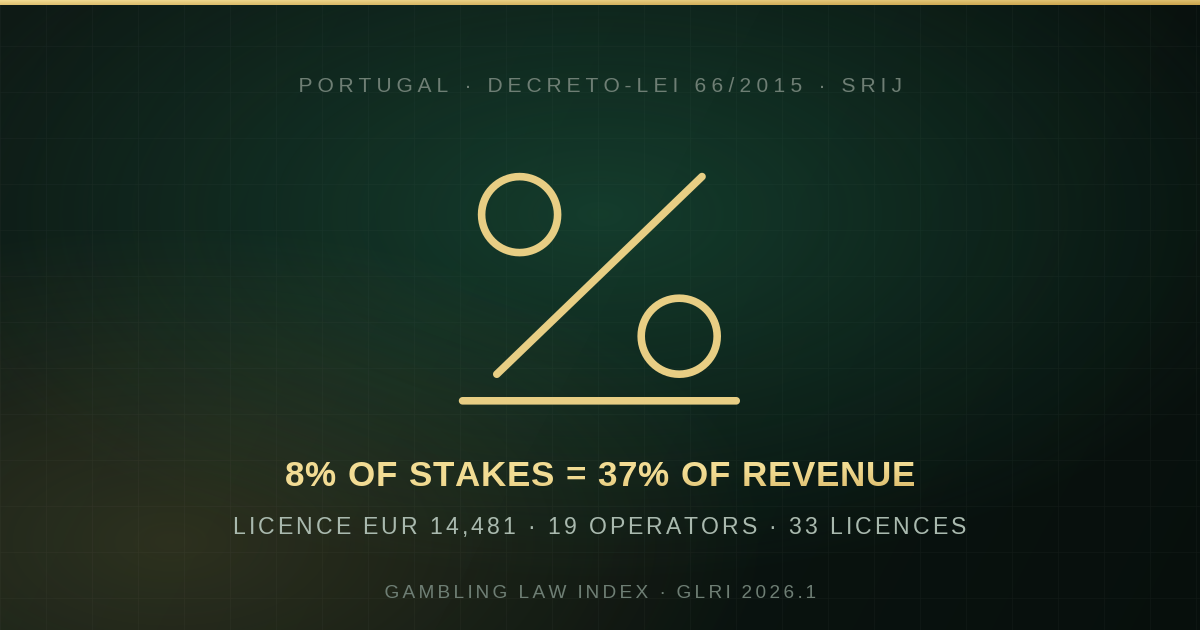
Guides still quote EUR 12,000 for a Portuguese licence. That was the 2015 figure. The fee has been indexed every March since and stands at EUR 14,481.10. The number that decides the business case is elsewhere: betting is taxed on stakes, and on the regulator's own data that came to 37% of betting revenue over the last four reported quarters.
A Portuguese online gambling licence is a three-year authorisation issued by the Comissão de Jogos of Turismo de Portugal, through its regulator SRIJ, under Decreto-Lei 66/2015 (RJO), for one category: fixed-odds sports betting, horse-race betting, bingo, or games of chance.
Quick facts
| Parameter | Value |
|---|---|
| Regulator | Serviço de Regulação e Inspeção de Jogos (SRIJ), part of Turismo de Portugal, I.P.; licences are issued by its Comissão de Jogos |
| Licence types | Fixed-odds sports betting; horse-race betting (pool and fixed-odds); bingo; games of chance (slots, roulette, blackjack, baccarat, banca francesa, poker). One licence per category (RJO art. 12(1)) |
| Fees from 1 March 2026 | Licence issue or renewal EUR 14,481.10 (bingo EUR 2,413.52); first system approval EUR 21,721.65 plus EUR 2,413.52 per betting category and per game type (Portaria 211/2015, indexed) |
| Bonds | EUR 500,000 for player balances and fines, plus EUR 100,000 for the gambling tax, by bank deposit or first-demand guarantee; reviewed after six months of operation (art. 18) |
| Tax (IEJO) | 25% of gross revenue on games of chance and pool horse betting; 8% of stakes on fixed-odds sports and horse betting; 35% of commission on exchange betting (arts 89–91) |
| Term | Three years from issue, renewable for three-year periods; the renewal request is due 90 days before expiry (art. 20) |
| Who may apply | A private company in the form of a sociedade anónima or equivalent, seated in the EU or EEA; a foreign company needs a branch in Portugal (art. 9(1)). No cap on the number of licences |
| Register on 19 Nov 2026 | 19 operators holding 33 licences: 19 for games of chance, 13 for sports betting, 1 for bingo, none for horse racing |
The short answer
Portugal has licensed online gambling since 2015 under the Regime Jurídico dos Jogos e Apostas Online (RJO), approved by Decreto-Lei 66/2015. The regulator is the Serviço de Regulação e Inspeção de Jogos (SRIJ), a service of the national tourism institute. Its page on the legal framework says licences “can be requested at any time” and that there is no limit on their number.
The official costs are low by European standards:
- Licence issue or renewal: EUR 14,481.10 per licence, every three years.
- First approval of the gaming system: EUR 21,721.65, plus EUR 2,413.52 for each betting category and each type of game.
- Bonds: EUR 500,000 and EUR 100,000, as a bank deposit or guarantee.
The cost that matters is the tax. Games of chance pay 25% of gross revenue. Fixed-odds sports betting pays 8% of stakes. Using SRIJ’s quarterly reports for July 2025 to June 2026, we calculated what that 8% came to as a share of what operators kept: 37.2% of gross betting revenue.
What the licence costs: the March 2026 fee table
Fees are set by Portaria 211/2015. Its article 4 updates the amounts on 1 March each year in line with consumer prices. SRIJ publishes the current table; the page was last changed on 3 March 2026.
| Act | 2015 amount (Portaria annex) | From 1 March 2026 (SRIJ) |
|---|---|---|
| First approval (homologação) of the gaming system | EUR 18,000 | EUR 21,721.65 |
| Added per betting category and per game type | EUR 2,000 | EUR 2,413.52 |
| Licence issue or renewal: sports betting | EUR 12,000 | EUR 14,481.10 |
| Licence issue or renewal: horse-race betting | EUR 12,000 | EUR 14,481.10 |
| Licence issue or renewal: games of chance | EUR 12,000 | EUR 14,481.10 |
| Licence issue or renewal: bingo | EUR 2,000 | EUR 2,413.52 |
| Authorisation of a new game type outside the statutory list | EUR 2,000 | EUR 2,413.52 |
All three 2026 amounts are 20.68% above the 2015 ones. The guides we read in the search results still give EUR 12,000 and EUR 2,000.
Two worked examples, our calculation from the table:
| Casino only, slots | Sports betting plus casino with four game types | |
|---|---|---|
| System approval | EUR 24,135.17 | EUR 33,789.25 |
| Licence issue | EUR 14,481.10 | EUR 28,962.20 |
| Fees to SRIJ | EUR 38,616.27 | EUR 62,751.45 |
| Bonds under art. 18(1) | EUR 600,000 | EUR 600,000 |
The second column assumes one initial approval that covers the betting category and the four game types together (item 1.1 of the table, five increments). That is our reading of the table, not a figure SRIJ publishes. Renewal costs EUR 14,481.10 per licence every three years, or EUR 4,827.03 a year at today’s rate, and the rate will have been indexed again by then.
These are the regulator’s charges only. Certification by a recognised test lab, the Portuguese branch, local hosting and staff come on top, and none of them has a published tariff.
The bonds
Article 18(1) requires two bonds before the licence is issued:
- EUR 500,000 to secure the operator’s legal obligations, in particular the estimated balances of player accounts and any fines under the RJO.
- EUR 100,000 to secure payment of the online gambling tax (imposto especial de jogo online, IEJO).
Each may be a bank deposit or an autonomous bank guarantee payable on first demand, on SRIJ’s templates. The three licences issued in July 2026 all record a bank guarantee for both.
The starting amounts do not last. Under article 18(3), SRIJ reviews them six months after operations begin and whenever it sees fit. The first bond is reset to between 60% and 90% of the average balance of player accounts over a half-year. The second is reset to the average IEJO for two months. An operator with EUR 2 million of monthly casino revenue pays EUR 500,000 of IEJO a month, so its tax bond would move from EUR 100,000 to about EUR 1 million. If SRIJ orders a top-up, the period it sets cannot be shorter than 30 days (art. 18(7)), and failing to top up is a ground for revoking the licence (art. 23(1)(g)).
The statute speaks of what “the applicant” must provide. We did not find a statement from SRIJ on whether an operator applying for two licences posts the bonds once or twice.
The tax: 25% of revenue for casino, 8% of stakes for betting
IEJO is a monthly levy that SRIJ itself assesses. Under article 88(2) it sends the bill by the 5th of the following month and the operator pays by the 15th.
| Product | Base | Rate | Article |
|---|---|---|---|
| Games of chance (slots, roulette, blackjack, baccarat, poker, bingo) | Gross revenue, including commissions charged to players | 25% | 89 |
| Fixed-odds sports betting | Amount of the bets placed | 8% | 90(3) |
| Sports betting exchange, where commission is the only income | Commission | 35% | 90(7) |
| Pool horse-race betting | Gross revenue | 25% | 91(2) |
| Fixed-odds horse-race betting | Amount of the bets placed | 8% | 91(6) |
The consolidated text SRIJ publishes is dated 31 March 2020, after Lei 2/2020 replaced the earlier sliding scales with these flat rates. To check that they still apply, we recomputed the tax from SRIJ’s own quarterly figures. In each of the last four reports, 8% of betting stakes plus 25% of casino revenue comes within EUR 0.1 million of the IEJO that SRIJ says it collected.
| Quarter | Betting stakes | Betting gross revenue | Margin | 8% of stakes | As share of betting revenue | Casino gross revenue | IEJO reported |
|---|---|---|---|---|---|---|---|
| Q3 2025 | EUR 504.6m | EUR 99.7m | 19.76% | EUR 40.4m | 40.5% | EUR 197.4m | EUR 89.8m |
| Q4 2025 | EUR 571.1m | EUR 123.6m | 21.64% | EUR 45.7m | 37.0% | EUR 214.0m | EUR 99.3m |
| Q1 2026 | EUR 587.0m | EUR 119.5m | 20.36% | EUR 47.0m | 39.3% | EUR 204.2m | EUR 98.1m |
| Q2 2026 | EUR 515.6m | EUR 125.1m | 24.26% | EUR 41.2m | 33.0% | EUR 203.1m | EUR 92.1m |
| Four quarters | EUR 2,178.3m | EUR 467.9m | 21.48% | EUR 174.3m | 37.2% | EUR 818.7m | EUR 379.3m |
Stakes, revenue and IEJO are from the SRIJ reports. The margin, the 8% column and the shares are our arithmetic.
Over those four quarters the licensed market made EUR 1,286.6 million of gross revenue and paid EUR 379.3 million of IEJO, 29.5% of the total. Casino paid its 25%. Betting paid 37.2%.
A tax on stakes also means the burden on a bookmaker depends on its margin, and the tax is owed even on a losing month:
| Betting margin (revenue ÷ stakes) | 8% of stakes as a share of revenue |
|---|---|
| 5% | 160% |
| 8% | 100% |
| 10% | 80% |
| 15% | 53.3% |
| 20% | 40% |
| 25% | 32% |
| 32% | 25% |
A sportsbook priced the way it would be in a revenue-taxed market, at a margin under 8%, would owe more tax than it earns. The Portuguese market’s reported margin of about 21% is what the tax produces: operators keep more of each euro staked. Betting reaches the casino rate only at a 32% margin.
For contrast, Spain charges 20% of net income on all online products (see the Spain profile), and Denmark 28% of gross revenue.
My reading: the tax structure explains the shape of the register below. Every one of the 19 operators holds a games-of-chance licence, and none holds betting alone.
The register on 19 November 2026
SRIJ lists every licensed operator with its brand, .pt site, licences and each endorsement. We read the page on 19 November 2026 and counted.
| 30 Sep 2025 (SRIJ report) | 30 Jun 2026 (SRIJ report) | 19 Nov 2026 (our count) | |
|---|---|---|---|
| Licensed operators | 18 | 17 | 19 |
| Licences | 32 | 30 | 33 |
| Sports betting | 13 | 12 | 13 |
| Games of chance | 18 | 17 | 19 |
| Bingo | 1 | 1 | 1 |
| Horse-race betting | 0 | 0 | 0 |
What changed:
- One operator left. SRIJ’s first-quarter report says one licensed entity ended its activity for Portugal in the first quarter of 2026. Licence numbers run from 001 to 035, and numbers 021 and 022 are not on the list.
- Three licences were issued on 24 July 2026. Licences 033 and 034 went to Retabet Portugal, S.A. (sports betting and slots) and licence 035 to Play Jogo Limited, a Malta-seated company with a Lisbon branch, trading as Vincino (slots, blackjack and two roulette types). Each runs to 23 July 2029.
- No horse-racing licence is on the register.
Of the 19 operators, 13 hold both a betting and a games licence and 6 hold games only (PokerStars, 888, Versus, Bacanaplay, Vincino and YoBingo, which also has the one bingo licence). Eight of the 19 have Limited or P.L.C. in their name. Those are not Portuguese company forms, and article 9(1) makes a foreign company operate through a branch in Portugal.
The register also shows how products get added. Crash games (“Saque ou Crash”) are not in the statutory list of article 5; they appear as endorsements on existing games licences, each one an authorisation under article 12(2)–(4) that cost the holder a new approval and a fee.
Who may apply
Articles 9 and 13 to 16 set the conditions:
- Legal form and seat. A private company in the form of a sociedade anónima or equivalent, seated in an EU member state or an EEA state bound by administrative cooperation on tax and anti-money-laundering. A foreign company must have a branch in Portugal.
- Corporate object. It must cover the operation of games and betting for the whole licence term.
- Tax and social security in good standing in Portugal or in the state of the main establishment.
- Suitability. No insolvency, no ban on trading, and no final conviction in the last five years for the offences listed in article 14(4), among them fraud, illegal gambling, corruption and money laundering. The test covers the company and its legal representatives.
- Technical capacity. Qualified staff, and article 15(2) counts each technician for one operator only, even if that person also works for others.
- Financial capacity. Equity of at least 35% of net assets on the last balance sheet, confirmed by the supervisory board or statutory auditor (art. 16). A newly formed company with no balance sheet relies on the auditor’s opinion alone.
- A system plan that names where the gaming platform is hosted and gives an address in Portugal for the entry-and-registration infrastructure (art. 13(d)(ii)).
The articles we read set no minimum share capital. The July 2026 licences record EUR 200,000 for Retabet Portugal and EUR 50,000 issued for Play Jogo. Article 26(6) does require that at least 60% of the capital be in shares whose holders the company can identify at any time, with every transfer reported to SRIJ within 30 days.
How the procedure runs
- Application on SRIJ’s form, delivered to its Lisbon office or sent by registered post. Everything must be in Portuguese, with certified translations of foreign documents unless SRIJ waives them (art. 11).
- Corrections. If the file has gaps, the applicant gets 10 days to fix them (art. 11(5)).
- Certification. The gaming system is tested by one of the bodies SRIJ recognises. Its list, dated 18 February 2026, names nine, including GLI, iTech Labs, eCOGRA, BMM and Quinel.
- Approval (homologação) by SRIJ, which runs its own tests and connects the operator’s reporting to its control infrastructure, then charges the approval fee.
- Issue. The licence is issued once the system is approved and, within a period of at least 10 days that SRIJ sets, the bonds are posted, any fines are paid and the licence fee is paid (art. 17(2)).
Article 11 gives SRIJ no deadline to decide, and SRIJ publishes no processing times. Play may start only after the licence is issued, on a .pt site that carries nothing but the licensed games (arts 25 and 28).
What we could not verify
- The current consolidated statute. SRIJ’s own consolidated RJO is the version of 31 March 2020, and the official gazette’s consolidated page did not load for us on 19 November 2026. The tax rates are confirmed by the arithmetic above through June 2026, and the July 2026 licences cite the same decree and the three-year term. We cannot rule out later amendments to other articles.
- The third quarter of 2026. SRIJ’s most recent online report on the day we looked was the second-quarter one.
- Bonds for two licences, as noted above.
- Processing time, certification cost and the cost of the Portuguese branch and hosting.
- Which operator left in early 2026. SRIJ’s report does not name it and we have not guessed.
For the wider field, see our licence cost comparison and the guide to getting a licence step by step. The register counts on this page are also on our registers page.
Pitfalls and nuances
1 Budgeting with the 2015 fee table
EUR 12,000, EUR 18,000 and EUR 2,000 are the amounts in the annex to Portaria 211/2015. Article 4 of that Portaria updates them every 1 March. The 2026 amounts on the SRIJ page are 20.68% higher: EUR 14,481.10, EUR 21,721.65 and EUR 2,413.52.
2 Modelling the betting tax as a share of revenue
Article 90 charges 8% on the amount staked. The burden on revenue depends on the margin: 8% of stakes is 80% of revenue at a 10% margin and 40% at a 20% margin. It only falls to the casino rate of 25% at a 32% margin.
3 Treating the bonds as fixed at EUR 600,000
Article 18(3) has SRIJ review both bonds six months after launch: the first to 60–90% of the average half-year balance of player accounts, the second to two months of average tax. A top-up order must be met in the period SRIJ sets, which cannot be under 30 days.
4 Assuming one licence covers every product
Sports betting and games of chance are separate licences with separate fees. Within a games licence, each game type must be certified and approved before launch, and types outside the statutory list, such as crash games, need an authorisation recorded on the licence.
5 Serving Portuguese players from a .com
Article 28 requires a .pt domain to which all traffic from Portugal is redirected, and article 49 makes offering online gambling in Portugal without a licence, including from servers abroad, punishable by up to five years in prison or a fine.
Frequently asked questions
How much does a Portuguese online gambling licence cost?
From 1 March 2026, EUR 14,481.10 to issue or renew each licence, and EUR 21,721.65 plus EUR 2,413.52 per category or game type for the first system approval. Bonds add EUR 600,000.
How is online sports betting taxed in Portugal?
At 8% of the stakes placed, not of revenue. On SRIJ figures for the four quarters to June 2026, that equalled 37.2% of operators' gross betting revenue.
How long is a Portuguese online gambling licence valid?
Three years from the date of issue. It can be extended for further three-year periods if the holder applies 90 days before expiry and pays the fee again.
Can a company outside the EU get a Portuguese online gambling licence?
No. Article 9 of the RJO requires a company seated in an EU or EEA state. A foreign company from those states must also have a branch in Portugal.
Is a Malta or other EU gambling licence valid in Portugal?
No. Article 9(3) of the RJO says licences granted by other states are not valid in Portugal. An operator recognised elsewhere in the EU still needs an SRIJ licence.
How many licensed online gambling operators are there in Portugal?
On 19 November 2026 the SRIJ register listed 19 operators with 33 licences. SRIJ reported 17 operators and 30 licences on 30 June 2026.
Free editorial shortlist
Choosing a licensing firm?
Tell us your market, product and stage. We reply by email with firms from our index matched to that brief.
- No fee to you
- Firms cannot pay to be on it
- Any sponsored line is labelled (disclosure)
Sources cited
- Decreto-Lei n.º 66/2015, de 29 de abril — Regime Jurídico dos Jogos e Apostas Online (consolidated text published by SRIJ, version of 31 March 2020) — regulation
- Portaria n.º 211/2015, de 16 de julho — fees under the RJO (Diário da República, 1.ª série, n.º 137) — regulation
- SRIJ — Cauções, taxas e impostos (bonds, fees as updated on 1 March 2026, tax), page dated 3 March 2026 — regulator
- SRIJ — Entidades licenciadas (register of licensed operators, licences and endorsements), read 19 November 2026 — regulator
- SRIJ — Relatório 2.º trimestre 2026, Atividade do Jogo Online em Portugal (quarterly report) — official document
- SRIJ — Licença n.º 033, Retabet Portugal, S.A. (issued 24 July 2026) — official document
- SRIJ — Licenças (who may apply, conditions, term, renewal) — regulator
- SRIJ — Certificação (recognised certification bodies), page dated 18 February 2026 — regulator