South Africa · National Treasury · 20% on online GGR · MTBPS 21 Oct 2026 · provincial betting tax
South Africa's 20% Online Gambling Tax After the 2026 MTBPS: Still a Proposal, Costed on Top of Provincial Tax
In February 2026 the Treasury said draft legislation for a 20% national online gambling tax would follow later in the year. On 21 October the Finance Minister said the design will be announced in the February 2027 Budget instead. Western Cape bookmakers paid 6.49% of their revenue in provincial tax this year; the proposal would add 20 points on top.
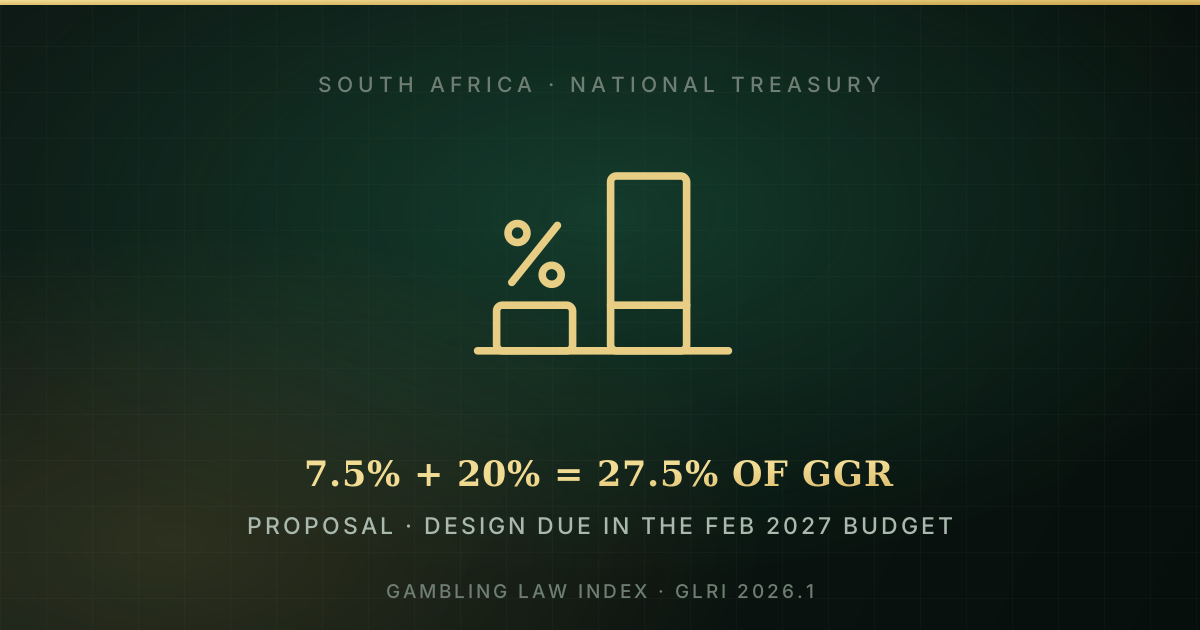
South Africa's national online gambling tax is a National Treasury proposal, published on 25 November 2025, for a 20% tax on gross gambling revenue from online betting and interactive gambling, charged in addition to provincial gambling taxes.
Quick facts
| Parameter | Value |
|---|---|
| Status, 26 October 2026 | Proposal only. No bill. MTBPS speech, 21 October 2026: final design to be announced in the February 2027 Budget |
| Proposed rate and base | 20% of gross gambling revenue (turnover less winnings) from online betting, including interactive gambling, in addition to provincial taxes (discussion paper, s. 7) |
| Provincial bookmaker tax today, Gauteng | 6.5% of gross betting revenue (reg. 270A) plus 1% Sports Development Fund levy (reg. 274), Gauteng Gambling Regulations GN 570 of 1997 |
| Provincial bookmaker tax today, Western Cape | R692.4m on R10.66bn sports-betting GGR, January to July 2026: 6.49% (WCGRB collection statistics) |
| Combined rate if adopted as proposed | 27.5% in Gauteng; about 26.5% on Western Cape's measured rate. Treasury's paper gives 26% to 29% |
| Treasury revenue estimate | Over R10bn a year. 20% of the R44.46bn online betting GGR in the paper is R8.89bn |
| Online casino | Still unlawful: s. 11 National Gambling Act 2004. The 2008 Amendment Act's interactive-gambling provisions were never brought into force |
| Comment period | Opened 25 November 2025, extended from 30 January to 27 February 2026 |
Where the proposal stands on 26 October 2026
National Treasury published The case for a national online gambling tax on 25 November 2025. It proposes “a 20 per cent tax … on gross gambling revenue from online betting, including interactive gambling, which would be in addition to the currently applied provincial taxes” (section 7). Gross gambling revenue (GGR) is turnover less winnings paid to players. The paper is explicit that raising money is not the aim: “the main objective of the reform would not be to raise further revenue, but rather to discourage problem and pathological gambling”.
Since then the timetable has moved twice. We read each step in the Treasury and Parliament documents themselves.
| Date | Document | What it says |
|---|---|---|
| 25 Nov 2025 | Treasury media statement and discussion paper | 20% on online GGR, on top of provincial tax; comments by 30 January 2026 |
| 15 Jan 2026 | Treasury media statement | Deadline extended to 27 February 2026 at stakeholders’ request (the statement is dated “15 January 2025”; the file is in Treasury’s 2026 folder) |
| 25 Feb 2026 | 2026 Budget Review, ch. 4 | After a workshop with commenters, a proposal “will be included in draft legislation that will be made available for public comment later in the year” |
| 27 Feb 2026 | — | Comment period closes, two days after the Budget |
| 21 Oct 2026 | MTBPS speech | Submissions “generally recognised the need to address the growth of online gambling”; consultations continue on the design, “its linkages to the existing regulatory framework, and the implications for provinces and the currently regulated market”; “An announcement of the final design will be made in the February 2027 Budget.” |
The MTBPS speech mentions no draft bill. 330 days after the paper was published, the tax has no legislative text, and the rate, the base and how it interacts with provincial taxes are all described by the Minister as open. Anyone modelling South African betting margins for 2027 should treat the 20% as a scenario.
What 20% adds to today’s provincial tax
Gambling, other than lotteries and sports pools, is a concurrent national and provincial competence under Schedule 4 Part A of the Constitution, and provinces tax it through their own gambling acts. The national tax would sit on the same GGR base as these provincial taxes; it would not replace them. So the starting point is what bookmakers pay now, and that differs by province.
Gauteng. Regulation 270A of the Gauteng Gambling Regulations (GN 570 of 1997, as substituted from 1 April 2018) charges betting tax and levies at 6.5% of a bookmaker’s gross betting revenue on events other than horse racing. Gross betting revenue is “hold less take out”, and a negative month can be carried forward for three months only (reg. 270A(4)). Regulation 274 adds a 1% Sports Development Fund levy on the same revenue. Returns and payment are weekly, by Wednesday (reg. 271), and late tax attracts a penalty of 10% a week, capped at twice the tax (reg. 272). Total: 7.5%.
Western Cape. The board’s published Gambling and Racing Regulations set the bookmaker’s tax at 3% “in respect of all winning bets” (reg. 70(2)) and a further 3% betting levy on the same winning bets (reg. 71(2)), with weekly returns by Thursday. The board’s own collection figures show what that comes to:
| Western Cape sports betting, 2026 | Turnover | GGR | Tax collected | Tax as % of GGR |
|---|---|---|---|---|
| January | R27.42bn | R1,434.1m | R93.4m | 6.51% |
| February | R27.18bn | R1,147.0m | R74.2m | 6.47% |
| March | R37.97bn | R1,718.7m | R111.6m | 6.49% |
| April | R29.80bn | R1,479.0m | R96.1m | 6.50% |
| May | R39.83bn | R1,995.0m | R129.5m | 6.49% |
| June | R30.37bn | R1,450.9m | R94.1m | 6.49% |
| July | R31.78bn | R1,439.7m | R93.6m | 6.50% |
| January to July | R224.35bn | R10,664.4m | R692.4m | 6.49% |
Source: WCGRB tax collection statistics, “Updated July 2026”, read on 26 October 2026. Bookmakers in the province kept 4.75% of turnover as GGR. The tax ratio stays between 6.47% and 6.51% of GGR every month, which is what a charge set on revenue would produce; we could not find the text that links the winning-bets wording to that outcome, so treat the 6.49% as measured rather than as a statutory rate.
A 20% national tax on the same seven months of Western Cape GGR would have been R2.13bn, 3.08 times the R692.4m the province collected.
| On R100m of GGR | Gauteng today | Gauteng with 20% national tax |
|---|---|---|
| Provincial tax and levy (7.5%) | R7.5m | R7.5m |
| National online gambling tax (20%) | — | R20.0m |
| Total | R7.5m | R27.5m |
| GGR left before costs | R92.5m | R72.5m |
GGR left after gambling taxes falls by 21.6%. Treasury’s paper gives the combined rate as “between 26 per cent and 29 per cent”, which assumes provincial rates of 6% to 9%. On the two provinces we checked it is 27.5% (Gauteng) and about 26.5% (Western Cape). Corporate income tax comes after this, on profit.
The paper also notes where betting revenue sits: Western Cape produced 31.0% of national GGR in 2024/25 and Mpumalanga 29.9%, with Gauteng at 18.1%. We could not open the Mpumalanga regulator’s site, which sits behind a browser check, so its rate is not in this article.
Checking the R10bn estimate
The paper says that “at the current levels of gross gambling revenue, the 20 per cent tax on gambling would translate into over R10 billion in additional revenue”. Its own figures, taken from National Gambling Board statistics for 2024/25, do not quite get there on an online-only base:
- Betting GGR was R51.97bn, of which online betting was R44.46bn (85.5%).
- 20% of R44.46bn is R8.89bn.
- R10bn requires a base of R50bn. 20% of all betting GGR, retail included, is R10.39bn.
So either the estimate counts retail betting, which the proposal does not name, or it assumes interactive-gambling revenue that the official statistics do not record. The paper does not show the calculation. The gap matters to anyone who reads the R10bn as the size of the online market.
Taxing what the law still forbids
Section 11 of the National Gambling Act 2004 reads: “A person must not engage in or make available an interactive game except as authorised in terms of this Act or any other national law.” An interactive game is one played through an electronic agent over the internet, other than in licensed premises. The National Gambling Amendment Act 2008 would have created national interactive-gambling licences issued by the National Gambling Board and said a tax on interactive gambling would be imposed by separate legislation. It only comes into force on a date the President fixes by proclamation, and the Treasury paper confirms that “this has not yet happened”.
What is lawful online today is betting through a provincially licensed bookmaker. The paper quotes the National Gambling Board’s definition: a game played through a bookmaker licensed in South Africa “where the punter has no interaction with, or influence on, the outcome”. Online casino games are outside that.
The paper does not wait for the licensing question. Section 8 proposes that local online betting suppliers register with SARS and give it the information they already file with provincial boards, and that local players “involved in interactive gambling, which is still illegal … will also be subject to the proposed tax to the extent of the gross gambling revenue related to these activities”. Section 5 argues that a gambling tax can attach to whoever offers the service, “without limitation to licensed providers”. Paying the tax would not authorise the activity. Section 16 of the Act separately bars anyone from knowingly paying out winnings from unlawful gambling, and the paper records that authorised dealers decline foreign-currency purchases for offshore gambling.
The legislative route to licensing has not moved either. The private member’s Remote Gambling Bill (B11-2024) was introduced on 16 April 2024 and lapsed on 21 May 2024 under National Assembly rule 333(2), according to its PMG bill history. A new notice of intention to introduce a Remote Gambling Bill, by Roger Chance MP, was open for comment from 8 November to 7 December 2024. We found no tabled version of it on PMG on 26 October 2026.
The licence an online bookmaker needs now
Online sports betting runs on a provincial bookmaker licence. In the Western Cape the 2026 fee amendment (Provincial Notice 113, gazetted 31 March 2026) sets a R16,343 application fee and a R31,982 deposit for a bookmaker licence, then R3,278 a year in licence fees and R13,088 a year in investigation fees. Licensing, B-BBEE expectations and the other eight boards are covered in the South Africa gambling licence profile.
For comparison, Kenya charges its excise duty on deposits rather than on revenue, 5% on a wider base since 1 July 2026, on top of licence fees that reach KES 60m in year one (Kenya online gambling licence). Treasury’s paper cites Kenya’s experience with high stake-based duties as the risk of pushing players offshore. Licence fees in other markets are side by side in the all-jurisdiction cost comparison.
What we could not verify
- Other provinces’ rates. We checked Gauteng and Western Cape only. Mpumalanga, the second-largest province by GGR in 2024/25, was unreachable.
- Western Cape’s mechanism. The board’s regulations PDF is a 2016 consolidation that describes the tax by reference to winning bets; the measured 6.49% suggests a revenue-based outcome, and we did not find the amending text.
- The comment workshop. The Budget Review said Treasury would hold one; we found no public record of it.
- The R10bn base. The paper does not show how it was calculated.
- The final design. Rate, base, collection by SARS, and whether provincial tax is credited or simply added, are all due in the February 2027 Budget.
Regulator, fees, tax and status in one place: South Africa gambling licence.
Pitfalls and nuances
1 Budgeting for the tax from 2026
The 2026 Budget Review promised draft legislation later in 2026. The MTBPS on 21 October replaced that with a design announcement in February 2027. Nothing is in force, and the rate and base can still change.
2 Using the R10bn estimate as a check on your own model
20% of the R44.46bn online betting GGR in Treasury's own paper is R8.89bn. The R10bn figure needs a base of R50bn, roughly all betting GGR including retail.
3 Assuming a 6% to 9% provincial rate everywhere
Provinces set their own rates and bases. Gauteng is 7.5% of gross betting revenue including the levy; Western Cape's regulations describe a charge on winning bets that lands at 6.49% of GGR in practice.
4 Reading a tax on interactive gambling as legalisation
Section 11 of the National Gambling Act 2004 still bars interactive games. The paper would tax that revenue without licensing it, and authorised dealers must still decline foreign-currency purchases for offshore gambling.
5 Waiting for the Remote Gambling Bill
Private member's Bill B11-2024 was introduced on 16 April 2024 and lapsed on 21 May 2024. A new member's notice was published for comment in November 2024. No tabled successor appears on PMG.
Frequently asked questions
Has South Africa introduced a 20% online gambling tax?
No. It is a Treasury proposal from November 2025. On 21 October 2026 the Finance Minister said the final design will be announced in the February 2027 Budget. No bill has been published.
What would the total tax on South African online betting be?
About 27.5% of gross gambling revenue in Gauteng (6.5% tax plus 1% levy plus 20%) and about 26.5% on Western Cape's measured 2026 rate, if the 20% is adopted as proposed.
Would the national tax apply to online casinos?
The paper says GGR from interactive gambling would be taxed too, even though section 11 of the National Gambling Act 2004 still prohibits it. Taxing it would not make it lawful.
Who would collect the national online gambling tax?
The paper proposes that online betting suppliers register with SARS and give it the information they already give provincial boards. The final collection design has not been announced.
How much do bookmakers pay in provincial tax now?
Gauteng charges 6.5% of gross betting revenue plus a 1% levy. Western Cape collected 6.49% of sports-betting GGR from January to July 2026. Other provinces were not checked.
Free editorial shortlist
Choosing a firm for a South Africa licence?
Tell us your market, product and stage. We reply by email with firms from our index matched to that brief.
- No fee to you
- Firms cannot pay to be on it
- Any sponsored line is labelled (disclosure)
Sources cited
- National Treasury: The case for a national online gambling tax, draft discussion paper (25 November 2025) — official document
- Minister Enoch Godongwana: Medium-Term Budget Policy Statement 2026 speech (21 October 2026), Parliament of South Africa — official document
- National Treasury: 2026 Budget Review, Chapter 4, Revenue trends and tax proposals (25 February 2026) — official document
- National Treasury media statement: extension of the comment period to 27 February 2026 — official document
- Gauteng Gambling Regulations, GN 570 of 1997, as amended (Gauteng Gambling Board) — regulation
- Western Cape Gambling and Racing Regulations (Western Cape Gambling and Racing Board) — regulation
- Western Cape Gambling and Racing Board: tax collection statistics (updated July 2026) — regulator
- Western Cape Gambling and Racing Regulations (Fees and Costs), 2016: Amendment, 2026 (Provincial Notice 113, Provincial Gazette Extraordinary 9215, 31 March 2026) — regulation
- National Gambling Act 7 of 2004 (copy published by the Western Cape Gambling and Racing Board) — regulation
- Parliamentary Monitoring Group: Remote Gambling Bill (B11-2024), bill history — industry publication