El Salvador · LNB licensing · checked against the statute 2 October 2026
El Salvador Gambling Licence 2026: LNB Canon, the .sv Domain Rule and 12 Operators
Online gambling in El Salvador is a state activity that the lottery, the LNB, lets private operators run under licence. The price is a revenue share, not a fee, and the licence is built for the Salvadoran market, not for export.
An El Salvador gambling licence is a licence from the Lotería Nacional de Beneficencia (LNB), the state lottery that holds the exclusive right to online games and sports betting, issued for up to ten years for a USD 100,000 to 250,000 canon, followed by up to 25% of gross income less prizes from year two.
Quick facts
| Parameter | Value |
|---|---|
| Regulator | Lotería Nacional de Beneficencia (LNB), which is both operator and licensing authority (Law art. 7) |
| Legal basis | Decreto Legislativo 251, 21 December 2021, Diario Oficial 244, tomo 433, 22 December 2021; Reglamento: Decreto Ejecutivo 16, 29 June 2022 |
| Initial canon | USD 100,000 (investment up to USD 2m), USD 200,000 (up to USD 5m), USD 250,000 (above USD 5m) (Reglamento art. 14) |
| Recurring charge | From year two, up to 25% of the previous year's gross income minus prizes, paid monthly; set in the licence resolution (art. 14, as amended 2023) |
| Licence term | Up to ten years, fixed by the LNB; the grant decision cannot be appealed (Law arts 50-51) |
| Renewal fee | USD 25,000, paid within 10 working days of the renewal resolution (Reglamento art. 19) |
| Domain | A dedicated .sv site, and redirection of Salvadoran connections from any other domain the group owns (Law art. 40) |
| Licensed operators | 12 authorised online operators after three new licences between June 2025 and May 2026 (LNB report, as published by Yogonet, 13 August 2026) |
What the licence is
El Salvador does not run a conventional licensing regime. Article 7 of the Ley Orgánica de la Lotería Nacional de Beneficencia makes lottery, sports betting and online games “actividad exclusiva” of the LNB, the state lottery, and bars anyone else from running them without authorisation. The same article lets the LNB authorise third parties as operators by permit, licence, agreement, contract, concession or public-private partnership, provided there is a general interest. Everything else follows from that: the licence is a concession from a state monopoly, and the LNB is at once the regulator, a competitor and the beneficiary of the revenue.
The law was approved by the Legislative Assembly on 21 December 2021 with 63 votes and published in Diario Oficial 244 (tomo 433) the next day. It entered into force eight days after publication (art. 112). It replaced a 1960 statute. The Reglamento, Decreto Ejecutivo 16, is dated 29 June 2022. Decreto 31 amended it in August 2023, including the article that sets the canon.
What it costs
Article 52 of the law says the canon is paid after the permit is granted and before the licence is issued, and calculated from the licence term and the operator’s initial investment, with any percentage on investment or balance sheet capped at 30%. The Reglamento sets the numbers in article 14.
| Charge | Amount | Source |
|---|---|---|
| Initial canon, declared investment up to USD 2m | USD 100,000 | Reglamento art. 14 |
| Initial canon, investment up to USD 5m | USD 200,000 | Reglamento art. 14 |
| Initial canon, investment above USD 5m | USD 250,000 | Reglamento art. 14 |
| From year two to expiry | Up to 25% of the prior year’s gross income minus prizes, paid monthly | Reglamento art. 14, as amended by Decreto 31 (2023) |
| Renewal of the licence | USD 25,000 | Reglamento art. 19 |
| Bond or guarantee | Amount set by the LNB per licence and renewed each year; it must run past each licence year to cover the last month’s prizes | Law art. 36; Reglamento arts 15-18 |
| Fines | 3 to 300 urban commercial-sector minimum salaries | Law art. 102 |
Neither text we read contains a gambling-specific tax beyond the canon. General Salvadoran taxes apply under other laws, which this page does not cover.
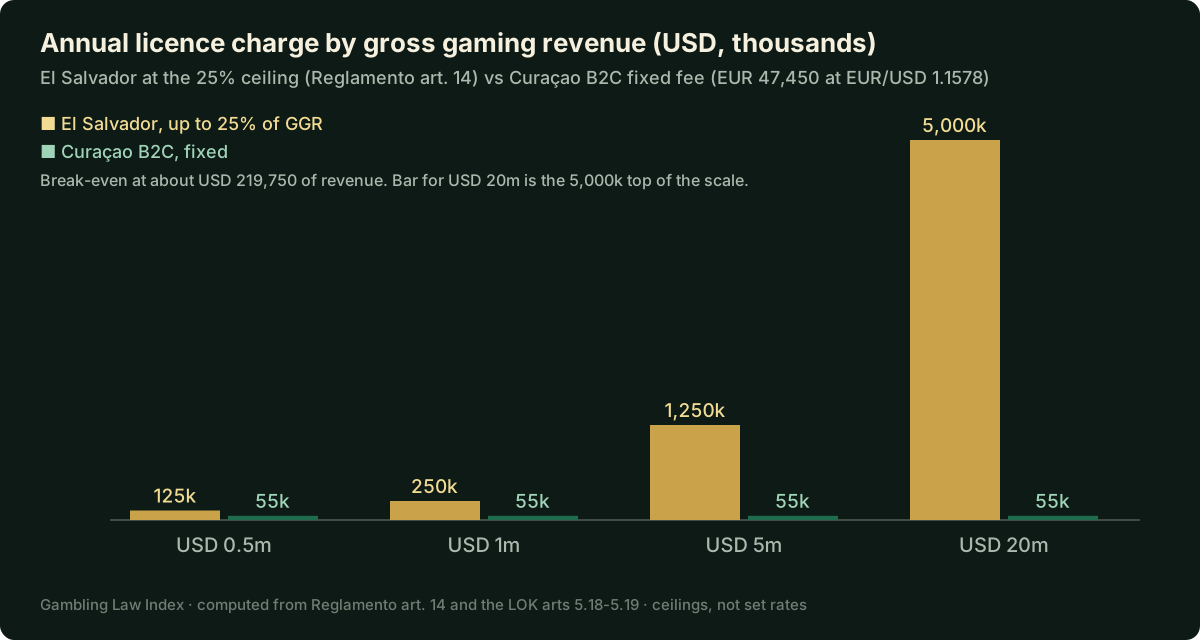
The annual share is the number that matters. “Gross income minus prizes” is gross gaming revenue, and the percentage is fixed in each licence resolution, with 25% as the ceiling. Set against a fixed-fee regime such as Curaçao’s EUR 47,450 a year for a B2C licence (about USD 54,900 at the EUR/USD rate of 1.1578 on our Curaçao cost page), the ceiling works out as follows.
| Annual gross gaming revenue | El Salvador, at the 25% ceiling | Curaçao B2C fee, as % of GGR |
|---|---|---|
| USD 500,000 | USD 125,000 | 11.0% |
| USD 1,000,000 | USD 250,000 | 5.5% |
| USD 5,000,000 | USD 1,250,000 | 1.1% |
| USD 20,000,000 | USD 5,000,000 | 0.3% |
At the 25% ceiling the two costs are equal at about USD 219,750 of annual revenue. Below that the Curaçao fee is the larger, above it the Salvadoran share is. At USD 4m of annual revenue the Salvadoran ceiling is USD 1m a year, about USD 83,300 a month, and a ten-year licence at that level would cost up to USD 9.1m in canon and share combined. These are ceilings; the LNB may set a lower percentage, and we have found no published licence resolution that shows what it has set.
One check on the schedule. The LNB’s report for June 2025 to May 2026, as carried by Yogonet on 13 August 2026, says the LNB took USD 300,000 in initial canon from three new operators. That is exactly three times USD 100,000, the lowest tier, so the schedule is being applied as written. It also implies, though the report does not say so, that all three declared investment of USD 2m or less.
The domain and territory rules
Article 40 sets two obligations on operators of internet games. They must use a dedicated site on a .sv domain for their gambling activity, and they must redirect to that site every connection from a location in El Salvador, or using a Salvadoran user account, that arrives through a site on any other domain owned or controlled by the operator, its parent or its affiliates.
Article 39(c) adds that operators carry on their activity at national level, within the territorial scope fixed in the licence. Article 45 tells the LNB to weigh, among other things, local market demand, the public revenue the operation will generate and whether the grant is “in the best interest of the citizens of El Salvador”. Article 2 states the guiding principle that every operator must contribute to the State’s social-development spending through the LNB’s charity programme.
Read together, the licence authorises a Salvadoran-facing business with a Salvadoran-domain front end. We found no provision that recognises it elsewhere, and none that creates a licence class for serving foreign markets. Whether the LNB would license an operator whose customers are all outside El Salvador is not answered by the text. An applicant who needs that answer must get it from the LNB in writing.
How the process runs
The licence follows a permit. Articles 63 to 67 fix the periods the LNB’s Compliance and Oversight Department and Board must observe.
| Step | Period in the law | Article |
|---|---|---|
| Review of the filing; queries or move to inspection | 10 working days | 63 |
| Applicant answers queries | 5 to 20 working days, extendable once by up to 20 | 63 |
| Admission of the application | 5 days after queries are cured | 64 |
| Inspection and technology approval | Within 10 days of admission; up to 10 more, extendable by the same period | 64 |
| Department’s opinion to the Board | 10 working days | 66 |
| Board resolution | 10 days from the opinion | 67 |
| Payment order, canon, then the licence resolution | After the permit, on payment | 52, 67 |
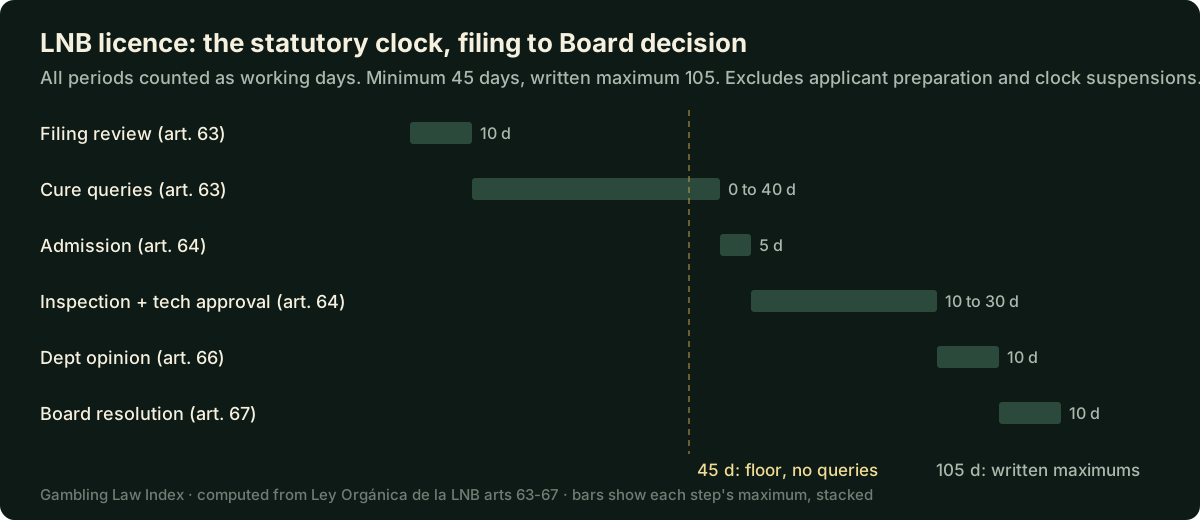
Counting every period as working days, the floor with no queries is 45 days and the ceiling on the written maximums is 105 days. Both leave out the applicant’s time to assemble the file. Article 68 lets the Board ask for more information or order further inspection before deciding, the Department’s opinion is not binding on it, and article 20 of the Reglamento suspends the clock while the LNB waits. A vendor figure of two to three months sits inside this range but covers none of those exceptions.
The file itself is heavy for an offshore vehicle. Article 12 of the Reglamento lists, for a company, certified incorporation documents whose corporate purpose is preponderantly lottery, sports betting, online games or similar, a shareholder register, and for each individual shareholder a net-worth statement showing the source of funds, two years of tax returns, a CV, links to other licensed operators, a sworn statement and a credit report. Corporate shareholders file two years of accounts, or the equivalent in their home country. Article 13 adds a ten-year viability study, an operating programme with responsible-gambling and anti-money-laundering controls, an investment plan, game rules, a technology report and, since 2023, proof of sector experience. Article 21 requires international certification of software and systems.
Control, revocation and enforcement
The licence cannot be sold. Article 57 makes every licence non-transferable and says that a change of 50% or more of the shares, any new shareholder, or any other change the LNB treats as a transfer of control requires a new licence application and payment before the change takes effect. Article 38 separately requires notice to the LNB of any change in composition, domicile, capital or ownership within ten working days.
Article 50 calls a licence a revocable privilege with no acquired rights, and says the Board’s resolution to deny, revoke, authorise, condition or restrict one admits no administrative appeal. Article 62 lists the grounds for extinction, among them two very serious infractions within a year and a year without activity. Operating without authorisation is “prohibida e ilegal” (art. 61) and a very serious infraction (art. 98).
Enforcement reaches the network. Article 16(l) lets the LNB’s Board order internet providers to block IP addresses and domains used for unauthorised games, as a precaution, a penalty or as part of its regulatory power. Reglamento article 26 routes the order through the telecommunications regulator, SIGET. Reglamento article 44 adds provisional closure and blocking of a website or platform. A site without an LNB licence that accepts Salvadoran players is therefore within reach of a block order, whatever its home licence.
Who holds licences
The LNB’s work report for June 2025 to May 2026, as published by Yogonet, says it granted three new licences for online games and sports betting, bringing the number of authorised operators to 12. The report as published does not name them. We have not seen the LNB’s own list, because the LNB site refuses automated requests from our servers, so we do not publish a roster.
What the text does not settle
Three points stay open after reading the law and the Reglamento.
- Prize cap. Article 77 limits prizes to 70% of the issue, or of income for games played online. It sits in the chapter on games the LNB itself operates. Article 58(f) says a licence may not set prizes above the percentage fixed in the Reglamento, and we found no such percentage in the Reglamento’s 59 articles. Whether 70% binds licensees is not clear from the text.
- Base of the share. Article 52 of the law speaks of a yearly value plus a percentage of initial investment or balance sheet, capped at 30%. The Reglamento instead uses a share of gross income minus prizes, capped at 25%. We note the difference in basis and do not resolve it.
- Foreign-market use. As above, the statute is silent on serving players outside El Salvador.
What we could not read
The LNB’s download page returned a Cloudflare block from our machines. The law was read from the LNB-hosted PDF, which is the Legislative Assembly’s text. The Reglamento was read from vLex’s consolidated text, which reproduces the Diario Oficial and marks the Decreto 31 amendments; we did not read Decreto 31 in its own gazette issue. The Yogonet report is trade press summarising the LNB’s report, not the report itself. If the LNB’s current text differs from these, the LNB’s text governs.
How it compares
For the cheapest fixed-fee routes, see what a gambling licence costs in 2026 and our Curaçao cost page. Other Central American regimes are covered in the Costa Rica licence page and the Panama licence page; see also the Costa Rica jurisdiction profile and the Panama profile.
Pitfalls and nuances
1 Budgeting a fixed fee
The canon is USD 100,000 to 250,000, but from year two the Reglamento allows up to 25% of gross income minus prizes. At USD 4m of annual gross gaming revenue that is up to USD 1m a year, so a vendor's quote of the initial canon is the smallest part of the cost.
2 Treating it as an offshore licence
The law is written for the Salvadoran market: games run within the territory fixed in the licence (art. 39(c)), and the licensee's other domains must redirect Salvadoran users to the .sv site (art. 40). It carries no stated recognition outside El Salvador.
3 Counting on an appeal
Article 50 says the Board's resolution to deny, revoke, authorise, condition or restrict a licence admits no administrative appeal, and describes a licence as a revocable privilege with no acquired rights.
4 Restructuring after the grant
A change of 50% or more of the shares, or any new shareholder, requires a new licence before it happens (art. 57). Exit by selling the licensed company is therefore a new application, not a share sale.
5 Quoting 2-3 months from a vendor
The statute's own periods run 45 to 105 days from filing to Board decision, and they stop while the LNB waits for documents or inspections (Reglamento art. 20). The vendor figure leaves out the applicant's preparation and the post-grant steps.
Frequently asked questions
Who issues gambling licences in El Salvador?
The Lotería Nacional de Beneficencia (LNB). Article 7 of its organic law makes lottery, sports betting and online games its exclusive activity and lets it authorise third parties by permit, licence, contract or concession.
How much does an El Salvador online gambling licence cost?
An initial canon of USD 100,000, 200,000 or 250,000 depending on declared investment, then up to 25% of the previous year's gross income minus prizes from year two, paid monthly.
Does the licence need a .sv domain?
Yes. Article 40 requires a dedicated .sv site and redirection to it of connections from Salvadoran locations or accounts coming through any other domain the operator, its parent or affiliates control.
Can an El Salvador licence be used to serve players in other countries?
The statute does not say. It frames licensed activity as national, within the territory fixed in the licence (art. 39(c)), and contains no export or foreign-market licence class.
How long does an LNB licence take to obtain?
The statutory periods in articles 63 to 67 add up to 45 working days with no queries and about 105 on the written maximums, before the applicant's own document preparation.
Can an LNB licence be sold or transferred?
No. Article 57 makes licences non-transferable, and a change of 50% or more of shares, or any new shareholder, requires a new licence and a new payment before the change.
Free editorial shortlist
Choosing a licensing firm?
Tell us your market, product and stage. We reply by email with firms from our index matched to that brief.
- No fee to you
- Firms cannot pay to be on it
- Any sponsored line is labelled (disclosure)
Sources cited
- Ley Orgánica de la Lotería Nacional de Beneficencia, Decreto No. 251 (LNB-hosted PDF of the Legislative Assembly text) — regulation
- Reglamento de la Ley Orgánica de la LNB, Decreto Ejecutivo No. 16, consolidated text with amendments to Decreto No. 31 (vLex) — regulation
- Asamblea Legislativa: plenary approves the new LNB organic law, 21 December 2021 (63 votes) — official document
- Lotería Nacional de Beneficencia — official site — regulator
- Yogonet: LNB paid USD 38.2m in prizes and added three online licences, 13 August 2026 (reporting the LNB Memoria de Labores) — industry publication